


Liquid Argon Storage Tanks: An In-Depth Overview
Liquid Argon Storage Tanks: An In-Depth Overview
Description
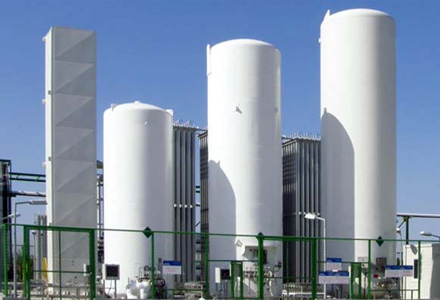
Liquid argon storage tanks are essential for safely and efficiently containing this vital industrial gas. These specialized tanks employ a double-walled, cylindrical design for optimal insulation and structural integrity. The inner cylinder and piping are constructed from high-grade S30408 stainless steel, chosen for its cryogenic compatibility and corrosion resistance. The outer shell is fabricated from Q245R alloy steel, providing robust structural support and containment.
Email: sales@jianshentank.com
Wechat/Whatsapp: +86 15517238365
Add: NO. 591 WENFENG ROAD, WENFENG DISTRICT, ANYANG, HENAN, CHINA
Liquid Argon Storage Tanks: An In-Depth Overview
Description
Liquid argon storage tanks are essential for safely and efficiently containing this vital industrial gas. These specialized tanks employ a double-walled, cylindrical design for optimal insulation and structural integrity. The inner cylinder and piping are constructed from high-grade S30408 stainless steel, chosen for its cryogenic compatibility and corrosion resistance. The outer shell is fabricated from Q245R alloy steel, providing robust structural support and containment.
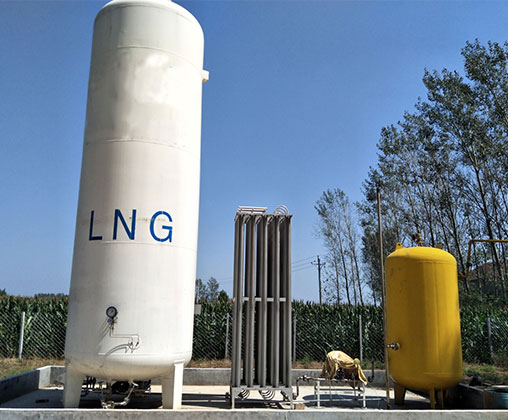
The interstitial space between the inner and outer shells is filled with expanded perlite, often referred to as pearl sand, a highly effective insulation material. Additionally, a specially treated desiccant is included within the insulation layer to maintain ultra-low moisture levels. A high vacuum (0.5 to 6 Pascals) is then drawn within this space, further enhancing thermal insulation performance. These tanks are typically available in capacities of 200 m³ or less. They are engineered for high working pressures, with two tanks at four separate workshops having a working pressure of 2.0 MPa. An external vaporizer is conveniently installed on the exterior of the tank, allowing for both easy filling and direct pressurized gas delivery.
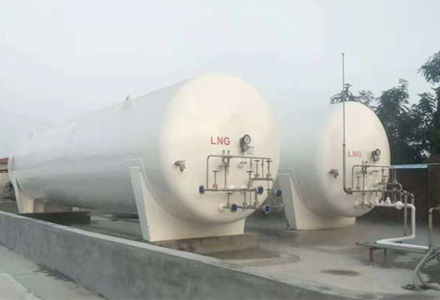
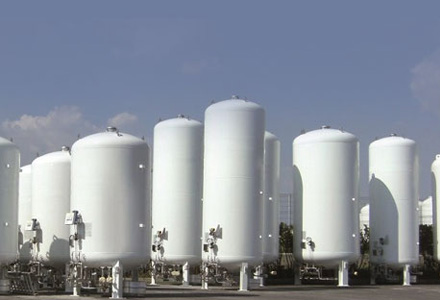
Depending on the intended use, storage tanks are classified as either stationary or transportable. Stationary tanks are predominantly employed for long-term cryogenic liquid storage at production facilities, points of use, or cryogenic liquid supply stations. Transportable tanks are designed for transferring low-temperature fluids from the production site or supply station to the point of consumption. These units, often seen in the form of road tankers, trailers, or marine tankers, facilitate the safe and efficient movement of liquid argon. Installation options include both vertical (L) and horizontal (W) configurations to accommodate various site requirements.
Liquid Argon Storage Tank: Key Features
Insulation Method: Vacuum Powder Insulation using expanded perlite.
Working Pressure Range: 0.2 - 3.0 MPa
Usable Volume: 5 m³ - 200 m³
Design Temperature Range: -196 °C to -50 °C
Filling Rate: 95%
Advantages: Advanced vacuum powder insulation; compact structure; minimal daily evaporation rate; small footprint; centralized management; safe and reliable operation; ease of use and maintenance.
Applications of Liquid Argon
Argon is an inert gas with a wide range of industrial and scientific applications, including:
Aluminum Production: Acts as a replacement for air or nitrogen, creating an inert atmosphere during aluminum manufacturing, degassing, and cleaning to remove impurities like hydrogen.
Steel Production: Used to displace gas or vapor, preventing oxidation in various processes. Employed to stir molten steel, maintaining consistent temperature and composition. Facilitates the removal of unwanted gases during degassing. Argon is also crucial in Argon Oxygen Decarburization (AOD) processes for stainless steel, helping to remove carbon monoxide and minimize chrome loss. Additionally, it is a carrier gas in chromatography for analyzing steel sample composition.
Metal Processing: Used as a shielding gas in welding applications, protecting against oxidation and nitrogen contamination in metal annealing and rolling processes. Also utilized for purging molten metal to reduce porosity in castings.
Electronics Manufacturing: Provides a protective atmosphere and heat dissipation medium for germanium and silicon crystals used in ultra-pure semiconductors.
Lighting Industry: Used in the filling of incandescent and fluorescent lamps and to produce blue light in xenon lamps.
Manufacturing Process
The production of these storage tanks follows a rigorous process:
Volume and Drawing Acquisition: Defining the tank's specifications based on client needs and producing the necessary technical drawings.
Material Preparation and Cutting: Precisely cutting raw materials according to the required tank dimensions.
Steel Rolling: Forming the steel plates into the cylindrical shapes required for the inner and outer tanks.
Steel Plate Welding: Joining steel plates using expert welding techniques to ensure robust and leak-proof construction.
Storage Tank Assembly: Assembling the inner and outer tanks and all their related components.
Filling with Insulation Material: Introducing the expanded perlite insulation into the space between the inner and outer vessels.
Creating a Vacuum: Evacuating the interstitial space between the tanks to achieve the required vacuum level.
RT and MT Inspection and Radiographic Testing: Conducting various non-destructive testing methods to ensure the structural integrity of the welded components.
Tank Derusting: Preparing the exterior of the tank by removing rust and scale to enhance coating adherence.
Installation of Various Valves: Installing all necessary valves and fittings to complete the system.
Key Advantages of Our Liquid Argon Storage Tanks
Adiabatic Performance: Our tanks utilize superior quality insulation materials (expanded perlite), advanced vacuum technology, and a proprietary filling process to ensure maximum thermal efficiency and minimal heat gain, resulting in lower evaporation rates. The surface is treated with sandblasting, derusting, blowing, spraying and other processes and uses two-component rapid solidification liquid coating.
Safety Features: We incorporate a dual-group safety valve system that allows one set to operate while the other undergoes maintenance, ensuring uninterrupted safety.
Integrated Management System: Our tanks feature pressure gauges, differential level indicators, and level comparison charts mounted on the top of the container for convenient monitoring of liquid levels and pressure fluctuations. This simplifies both the filling and discharge process.
Monitoring and Control Systems: Vacuum gauges, vacuum manometers, and vacuum valves are installed at the bottom of the tank, allowing for routine monitoring of the insulation vacuum level and the tanks safe operation.
Technical Specifications (Example Models)
| No. | Model | Media | Inner Tank Size (Dia x Thick, mm) | Outer Tank Size (Dia x Thick, mm) | External Size (Dia*H/L, mm) | Net Weight (kg) |
|---|---|---|---|---|---|---|
| 1 | JSSM5-L/0.8 | Argon | DN1400x2910x6/6 | DN1900x3550x8 | Φ1916*5262 | 3940 |
| 2 | JSSM10-L/0.8 | Argon | DN1800x3490x6/6 | DN2300x4100x8 | Φ2316*5965 | 6040 |
| 3 | JSSM15-L/0.8 | Argon | DN1800x5560x6/6 | DN2300x6170x8/8/8 | Φ2316*8035 | 8045 |
| 4 | JSSM20-L/0.8 | Argon | DN2200x4730x8/8 | DN2700x5340x8/10/10 | Φ2716*7361 | 9875 |
| 5 | JSSM30-L/0.8 | Argon | DN2400x6100x8/8 | DN2900x6780x10/10/12 | Φ2920*8881 | 14210 |
| 6 | JSSM50-L/0.8 | Argon | DN2700x8220x10/10 | DN3200x8970x10/10/12 | Φ3220*11222 | 21180 |
| 7 | JSSM5-L/1.6 | Argon | DN1400x2910x8/10 | DN1900x3550x8/8/8 | Φ1916*5229 | 4380 |
| 8 | JSSM10-L/1.6 | Argon | DN1800x3490x10/12 | DN2300x4100x8/8/8 | Φ2316*5965 | 6900 |
| 9 | JSSM15-L/1.6 | Argon | DN1800x5560x10/12 | DN2300x6170x8/8/8 | Φ2316*8035 | 9300 |
| 10 | JSSM20-L/1.6 | Argon | DN2100x5300x12/14 | DN2600x5950x8/10/10 | Φ2616*7933 | 11645 |
| 11 | JSSM30-L/1.6 | Argon | DN2400x6100x14/14 | DN2900x6780x10/10/12 | Φ2920*8881 | 16750 |
| 12 | JSSM50-L/1.6 | Argon | DN2700x8220x16/16 | DN3200x8970x10/10/12 | Φ3220*11187 | 25570 |
Note: This is a sample model listing. We also offer customized solutions according to specific client requirements.
Previous : LNG vaporizing station
Next : Cryogenic Dewar Cylinder





Comments